Joe Dawson
Martin EdenJoe Dawson is the experienced laundryman whose brisk competence draws Martin Eden into hotel work and whose eventual departure exposes the human cost of its relentless pace. He is at once an exacting practitioner of efficiency and a man driven to escape the labor that efficiency helps him endure; his partnership with Martin ends when they choose different lives beyond the laundry.
Identity and Introduction
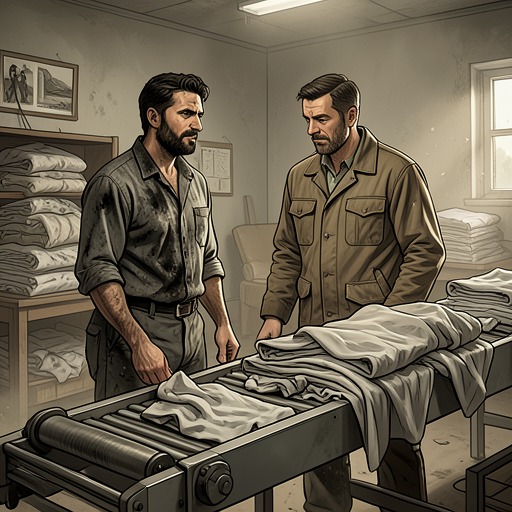
Joe is looking for a laundryman when he meets Martin, who lists hard labor and seafaring among his abilities and says he is willing to tackle almost anything. Martin balks at the prospect of ironing fine garments, but offers to do plain washing, a task he learned at sea. Joe considers the offer, then proposes that they join forces. The arrangement begins not with Martin’s confidence in laundry work, but with Joe’s practical recognition that the two can make a working partnership.
Joe’s first impression is confirmed by his method on the job. He works at an intense pace and watches closely for ways to save time, showing Martin where a task can be done in fewer motions. Martin names the principle as eliminating wasted movement and learns by copying his partner. Joe’s instruction is concrete: he teaches through demonstrations of work, while Martin absorbs each suggestion and takes pride in keeping up.
Skill and the Working Partnership
The shirt work shows the precision behind Joe’s speed. In one afternoon, he and Martin complete two hundred white shirts. Joe operates the tiler, in which a hot iron hangs from a steel string that supplies pressure; he finishes the yokes, wristbands, neckbands, and bosoms, then passes each shirt to Martin to iron the unstarched portions. The division of labor makes their pace possible, but it also binds each man to the other’s speed: Martin must catch and finish the shirts as quickly as Joe sends them along.
The work requires practiced judgment as well as repetition. Joe and Martin gauge iron heat by holding the irons close to their cheeks, and cool an overly hot iron by dipping it into water. Martin admires the fine accuracy the work demands, but has little leisure to contemplate it. Their hands move through a tightly ordered sequence, and the finished shirts must be tossed onto the receiving frame without rumpling. Joe’s expertise is real; so is the narrowness of the attention the job consumes.
The Cost of Toil
The laundry’s pace fills the working day and reaches into the margins around it. Joe and Martin labor late under electric lights, bolt their meals, and sometimes work before breakfast. The hotel’s guests can sit in cool white clothes on the verandas, but inside the laundry the stove roars, irons steam against damp linen, and workers’ hands repeatedly move between hot starch and cold water. The comfort being maintained outside depends on punishing heat and speed within.
Joe is the more practiced keeper of time, but his skill does not protect either man from exhaustion. Martin works fourteen hours, falls asleep over his books, and wakes stiff and chilled; during the heavier weeks, he gives up his cold baths and finds that work leaves little room even for thought. The contrast with his former life at sea is sharp: there, work had left him time to commune with himself, whereas the laundry manager seems to command his thoughts as well as his hours. Memories of Ruth Morse return only fleetingly when he is in bed or on his way to breakfast.
The routine also shapes their limited respite. Martin rides his bicycle seventy miles to Oakland on Saturday and the same distance back on Sunday, determined to save the two dollars and a half a train journey would cost. He returns weary but sober. Joe, by contrast, heads for a beer after the week’s work and proposes abandoning the job for a life on the road, imagining the appeal of having nothing to do. His recollection of being in hospital with typhoid makes enforced rest seem beautiful to him. These different responses do not change the conditions that have worn them down; they show the narrow choices those conditions leave them.
Leaving the Laundry
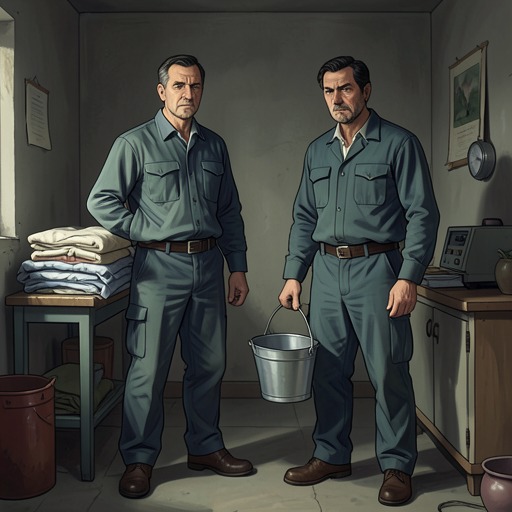
After several weeks, Martin’s weekend rides no longer provide rest. By the end of the seventh week, he goes with Joe to the village and drinks; months into the job, he recognizes that the labor itself is making a beast of him and sees drink as an effect of the work rather than its cause. Joe is alongside him in this decline, but the decision that follows is Martin’s as well as Joe’s: when Joe announces that there should be two laundrymen quitting, Martin asks why Joe is leaving, and Joe answers that it is for the same reason Martin is.
They do not leave immediately. Two new laundrymen arrive on Tuesday, and Joe spends the rest of the week explaining his system without doing the work himself. He refuses to resume labor, even if that means being fired, and looks instead toward freight cars and shade under trees. On Saturday, the men collect their pay and reach their parting. Joe asks whether Martin will change his mind and take to the road with him. Martin shakes his head, already standing by his bicycle, and the two shake hands; Joe holds on briefly before they separate.
Narrative Role
Joe’s importance lies in the contrast between command of a task and command of a life. He can divide motions, manage time, and teach another worker to make the same motions more efficiently, yet the laundry’s demands turn that efficiency into an instrument of further exertion. His skill makes the partnership work without making its conditions bearable.
His departure also clarifies the difference between the men’s forms of resistance. Joe wants to abandon labor for the road and its promise of idleness; Martin refuses the invitation and rides away on his own bicycle. Their shared reason for quitting brings them together at the moment their paths diverge. Joe’s arc in these scenes is therefore not a triumph over the laundry but a break from it: the work has exhausted him, and leaving is the limit of the freedom he can claim.